
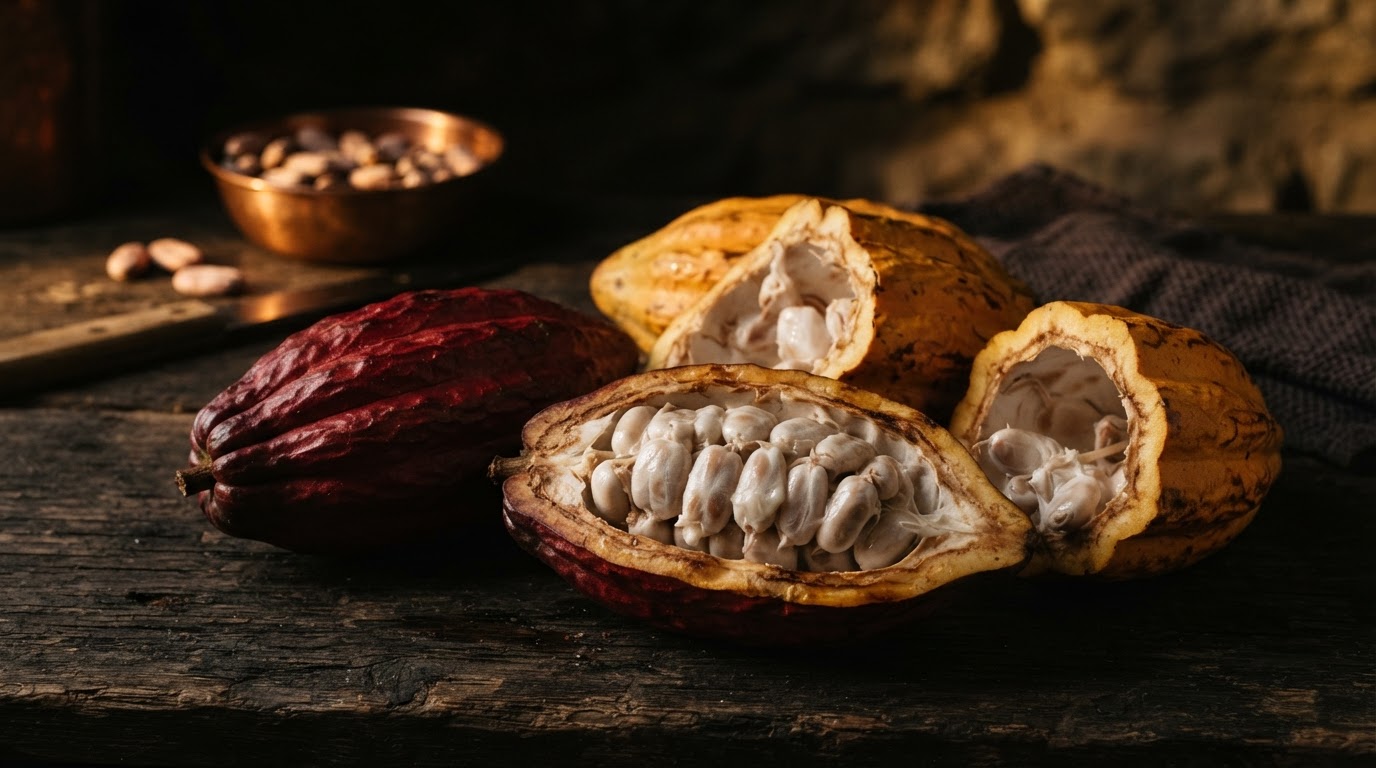
Borrowed from the wine world, terroir refers to the unique combination of soil, climate, topography, and human tradition that gives a crop its distinctive character. In cacao, terroir is not a marketing flourish — it is a measurable reality that shows up in every tasting note.
Cacao grows in a narrow band around the equator, roughly twenty degrees north and south of it. Within that band, the variation is enormous. Volcanic soils in Madagascar lend a bright acidity and vivid red-fruit notes. The clay-rich earth of Venezuela's Sur del Lago region tends toward deep caramel and walnut. Ecuador's Nacional cacao, grown in the humid lowlands, is famous for its floral aroma — the prized "arriba" flavor profile.
Elevation matters too. Cacao grown at higher altitudes develops slower, concentrating sugars and flavor precursors in the bean. Rainfall patterns influence fermentation — the natural yeasts that transform raw pulp into the foundation of chocolate flavor are themselves shaped by the local environment.
But terroir is only the beginning. The same bean, fermented and dried differently, can produce radically different chocolate. This is why a sommelier never judges origin alone — we judge the partnership between the land, the farmer's craft, and the maker's hand.
When you taste two single-origin bars side by side, you are tasting the earth itself. Learning to recognize those signatures is one of the most rewarding parts of the sommelier journey, and it is the heart of our Level I Chocolate-Tasting course.